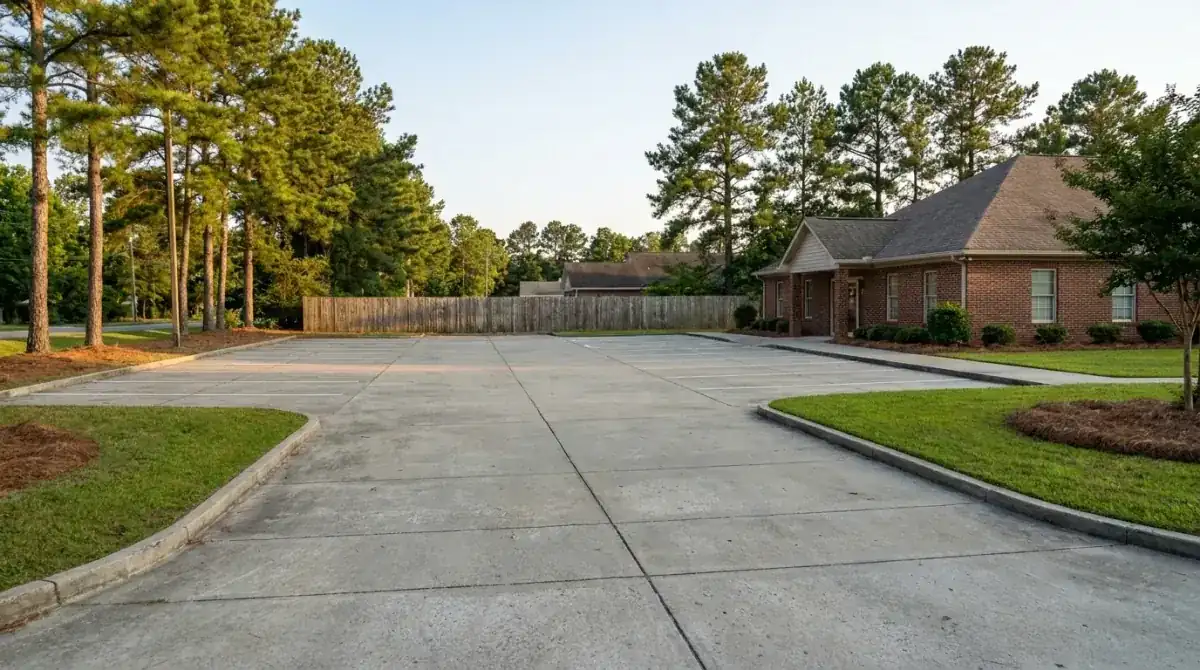
The town inspects, the county plans
The town's Inspections Department enforces the North Carolina Building Codes, reviews plans and approves permits for single-family and commercial construction. Applications and inspection requests now run through the town's online Customer Portal, which the town calls a new process, so set up your account before the week you want to pour.
Planning is shared. The town has no full-time Planning Director, and Cumberland County's Planning Department handles most planning items. The county helps complete some inspections, but the town is clear about one rule: every inspection must be scheduled through the town's Inspections office, not the county's. That split means a commercial owner may talk to both offices, in a set order. Zoning first, then the building permit, then inspections booked with the town. Our permit guide walks through that order for the county's towns.
The town's own page also names a Planning & Zoning Manager, so zoning questions have a person attached even without a Planning Director.
Dumpster enclosures and the wall rules in Section 42-191(3)
Fences don't need a permit in town, but they follow Ordinance Section 42-191(3), and its wall limits are worth reading before you plan a dumpster screen. Open fences and walls can be any height. Solid ones are capped at 3 feet inside a minimum front yard and 6 feet in a minimum side or rear yard. Within 25 feet of a public right-of-way line, nothing solid goes over 3 feet. Retaining walls are exempt from the setback rules in that chapter.
Why a concrete crew cares: the pad is sized to the enclosure, and the enclosure is sized to the rule. If your dumpster sits near the street and the town treats the screen as a solid wall, a 6 foot screen may not fit there, and you don't want to find out after the slab is poured. Ask the Inspections Department how the section applies to your enclosure, settle the height first, then we'll cut the pad to match. Ask the Inspections Department about driveway, apron and curb-cut rules for your street before you design the entrance.
Zoning first, then pad size, then the wall: that order keeps a concrete crew from pouring a slab the enclosure can't legally cover.
Flatwork runs $8 to $14 per sq ft for a reinforced 5 to 6 inch slab, priced per job after a site visit. These sizes multiply out from that range.
| Job | Size | Per sq ft | What it comes to |
|---|---|---|---|
| Dumpster pad and apron | 10x20 (200 sq ft) | $8 to $14 | $1,600 to $2,800 |
| Storefront walk | 5x80 (400 sq ft) | $8 to $14 | $3,200 to $5,600 |
| Service bay slab | 30x40 (1,200 sq ft) | $8 to $14 | $9,600 to $16,800 |
| Parking row | 18x90 (1,620 sq ft) | $8 to $14 | $12,960 to $22,680 |
Soil pockets that hold water, enclosure height limits, tear-out of an old surface and phased pours can move your total. Every price is confirmed in a free written estimate after we see the site.
Blaney, Lakeland and one wet pocket along the Little River
The Little River runs through town from west to east, and the ground on either side isn't uniform. In 30 sampled points, Blaney loamy sand showed up nine times, Lakeland sand or Lakeland-Urban land five, Candor sand three, and Tarboro and Fuquay two each. One point landed on a Torhunta and Lynn Haven soil, which is poorly drained.
Blaney is the soil to watch. NRCS puts it in drainage group C, with a loamy subsoil that drains moderately slowly, so water can hang around under a flat pad after a storm. Lakeland is the opposite: excessively drained, with rapid to very rapid permeability. Flood risk is light, with 28 of 30 sampled points in minimal-hazard Zone X and one in Zone AE. Run your address through the NC flood risk lookup, and we'll shape the pitch of your pad to the soil we find.