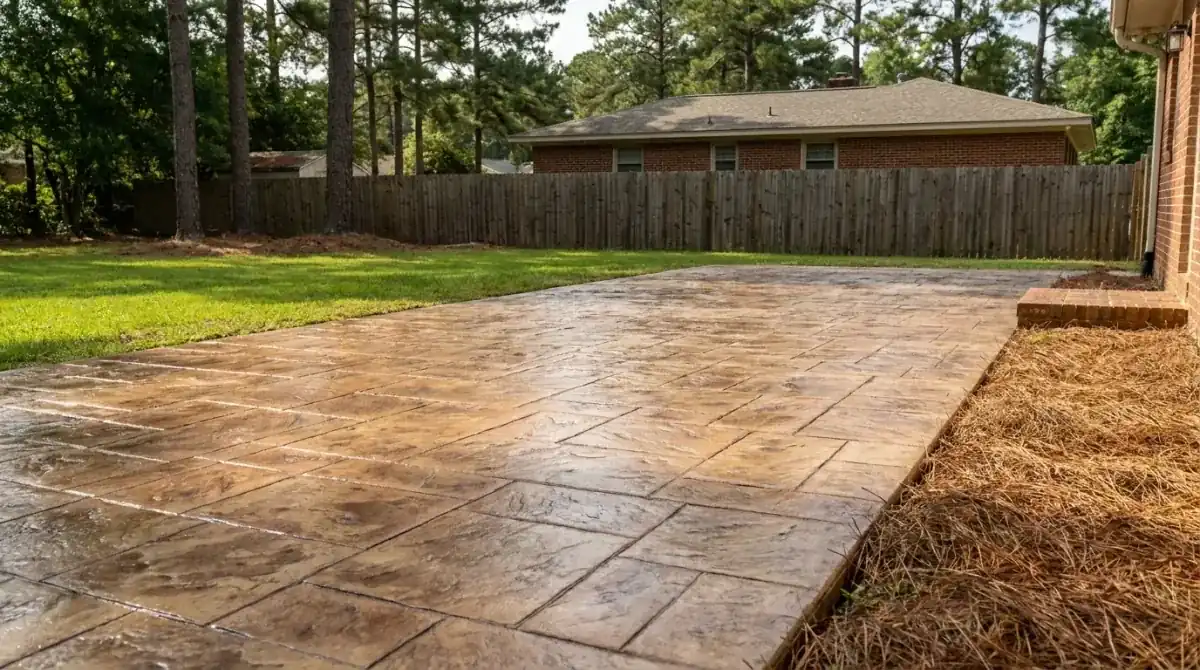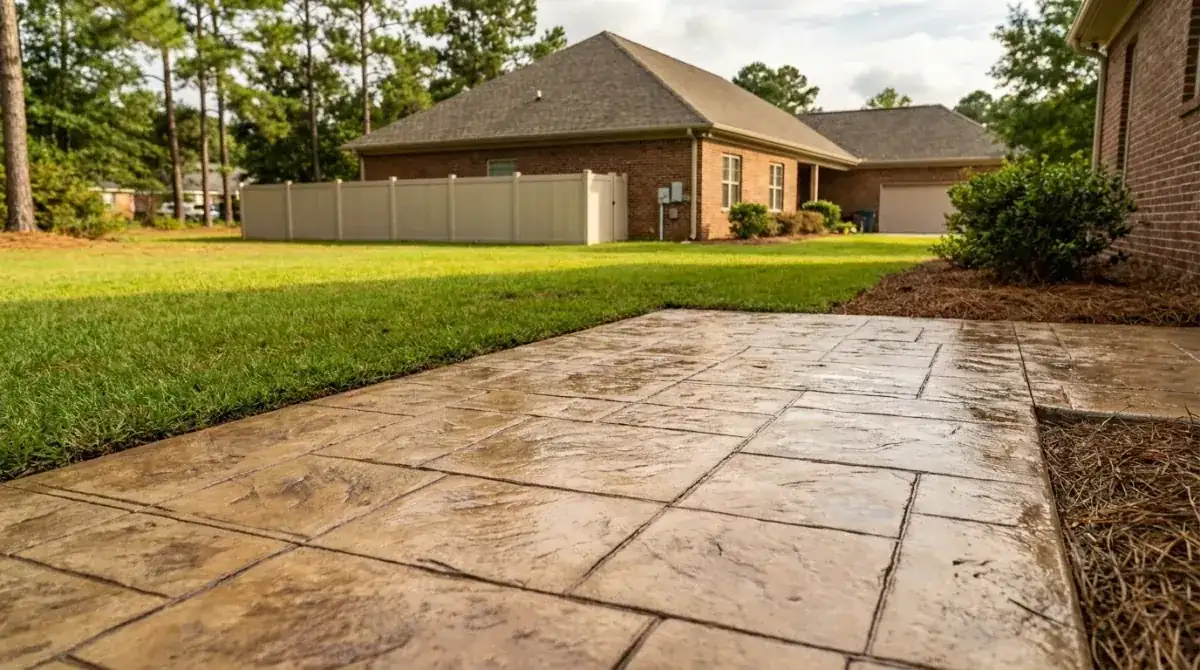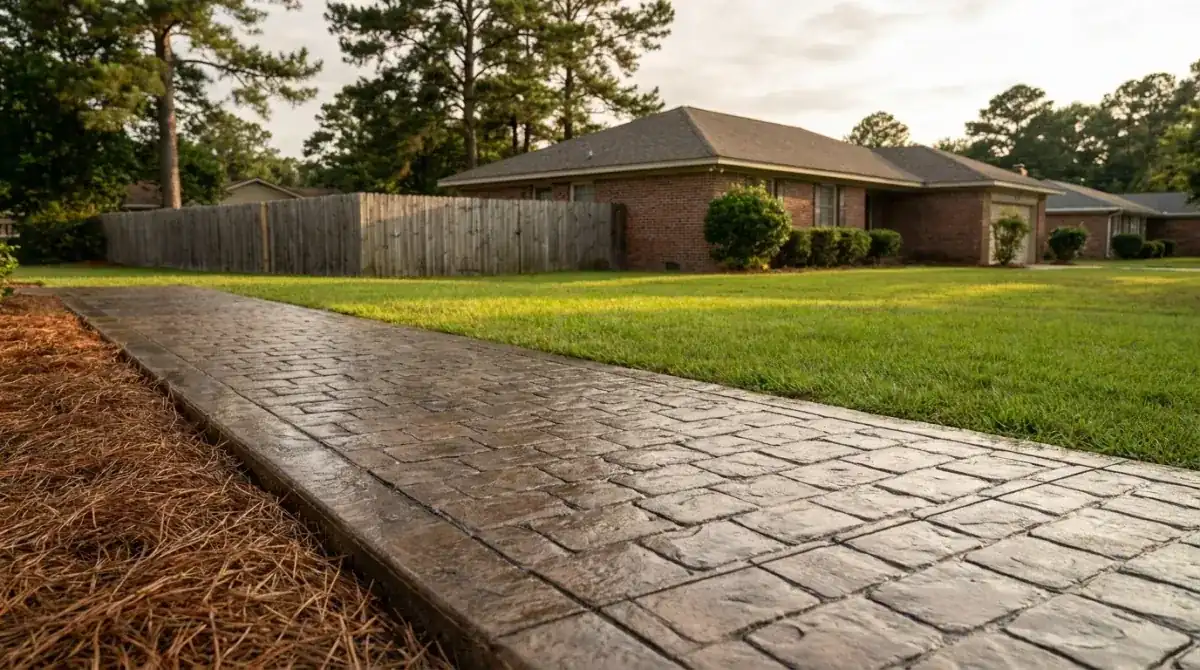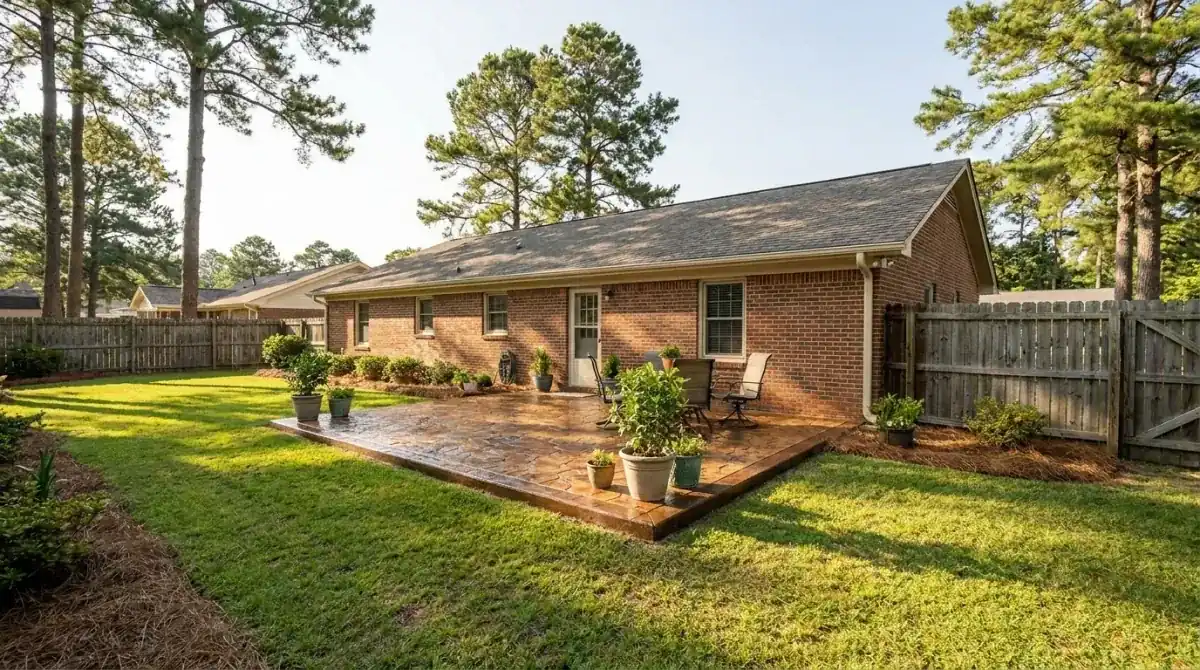
Slate, brick and flagstone looks for local houses
Stamping starts with a regular pour. While the surface is still soft, the crew spreads color and a release agent and presses rubber mats into it, one after another, to leave a texture. The color is mixed through the batch or broadcast on top, and the release agent keeps the mats from sticking. Patio patterns run from ashlar slate to cobblestone, herringbone brick, random stone and flagstone, and a covered porch can take a wood plank or tile look.
Match the color to the house first and the pattern book second. Hold a sample against your brick, siding and roof in daylight, and ask for a sample panel when the pattern is a big change from what you have now. A tan slate on a red-brick ranch reads differently from the same pattern on gray siding.
A stamped concrete contractor in Fayetteville starts with the slab underneath. That's a plain pour, so the base, the thickness and the joints we cover on our slab page still apply, and the pattern is a surface layer on top.
Pattern slab or pavers: price, heat and joints
Choosing between a patterned slab and pavers? Here's the quick comparison. A stamped slab is one pour with a pattern in the surface and planned joints through it, priced at $12 to $20 per sq ft. Pavers are individual units set over a leveled base, priced by the paver company and by the pattern. Our stamped concrete versus pavers guide runs the full comparison for local yards.
Heat is part of it. The airport weather station averages 70.5 days a year at 90 F or hotter, with a June through August average high near 89.8 F, according to NOAA's 1991 to 2020 normals. A dark surface sits in that sun all afternoon. Talk to us about color before you commit, and ask for a sample you can touch in the sun.
Joints are part of the design. A saw cut or a tooled joint follows the pattern lines, so we settle the layout with you before the pour.
A stamped concrete contractor in Fayetteville prices by the square foot, and ours runs $12 to $20 per sq ft, which puts typical stamped projects of 300 to 500 sq ft at $3,600 to $10,000. Stamped is priced separately from broom-finish work.
| Stamped project | Size | Per sq ft | What it comes to |
|---|---|---|---|
| Entry landing or small patio | 100 sq ft | $12 to $20 | $1,200 to $2,000 |
| Grill-and-table patio | 12x16 (192 sq ft) | $12 to $20 | $2,304 to $3,840 |
| Family patio | 300 sq ft | $12 to $20 | $3,600 to $6,000 |
| Large patio or walk | 500 sq ft | $12 to $20 | $6,000 to $10,000 |
| Stamped driveway | 24x30 (720 sq ft) | $12 to $20 | $8,640 to $14,400 |
Square-foot math only. Pattern, color, edge details, access and any tear-out of an old slab set where your project lands. We give a free written estimate after we see the site.
Where stamping works: patios, front walks and driveways
Patios are the easy yes, and a front walk works well at an entry. A driveway is where the city's rules come in. Under UDO Article 30-5, vehicular areas in the first 40 feet from the street are limited on a single-family lot to the greater of 33 percent of the front or corner-side yard or 750 square feet, and the surface has to be concrete, asphalt, brick, stone, pavers or aligned concrete strips. A patterned driveway counts as concrete, so the cap applies to it like any other driveway.
If your house sits inside one of the city's local historic districts, the rule gets stricter. The city's Historic Preservation page says a Certificate of Appropriateness is required for exterior work visible from a public street, including site features such as parking, landscaping and drainage, and building permits are not reviewed until it is approved. A stamped front walk or driveway on a street-facing lot in a district should start with a call to Planning.
Sidewalks along the street are a separate case. The UDO calls for public sidewalks with a brushed concrete finish, at least 5 feet wide outside the downtown district. Put the stamped pattern on your private walk and leave the public strip alone. See our patio page and driveway page for the base and permit details.