Eastover permits run through the county, not Town Hall
The Town of Eastover lists Cumberland County Planning and Inspections on its Services page, next to the sheriff and the fire department. That page lists no town building or zoning counter. Eastover is its own town, about 7 miles northeast of downtown Fayetteville, so the City of Fayetteville's permit desk isn't yours either. A slab, a garage or an addition gets its permit from the county office.
The county zoning ordinance, Section 108(A), makes it unlawful to start excavation or construction of any building or other structure, accessory structures included, until the zoning coordinator issues a zoning permit. Permits go void after six months without real progress. The ordinance doesn't name patios or driveways, so whether a stand-alone flatwork slab counts is a question for the county. Call and get the answer instead of guessing.
Our permits guide covers how the counties compare. For Eastover that means one county desk, one zoning permit question, and a state permit if your driveway meets a state road.
Ridges and bottomland: reading Eastover's soil map
Eastover has more than one kind of ground. We matched 60 spots scattered across the town to the USDA soil survey. The most common map units were Roanoke and Warne soils (12 spots), Lakeland sand (7), Lakeland-Urban land complex (5), Cape Fear loam (5), Altavista fine sandy loam (5), Johnston loam (4), Wagram loamy sand (3) and Candor sand (3).
That list splits two ways. Lakeland is excessively drained sand, dry and fast. Roanoke is poorly drained, and Cape Fear and Johnston are very poorly drained. NRCS rates Roanoke, Cape Fear, Johnston and Altavista as very limited for dwellings without basements, and Lakeland as not limited. Drainage and subgrade prep matter more here than in Hoke County, and two lots a mile apart can act like they're in different counties.
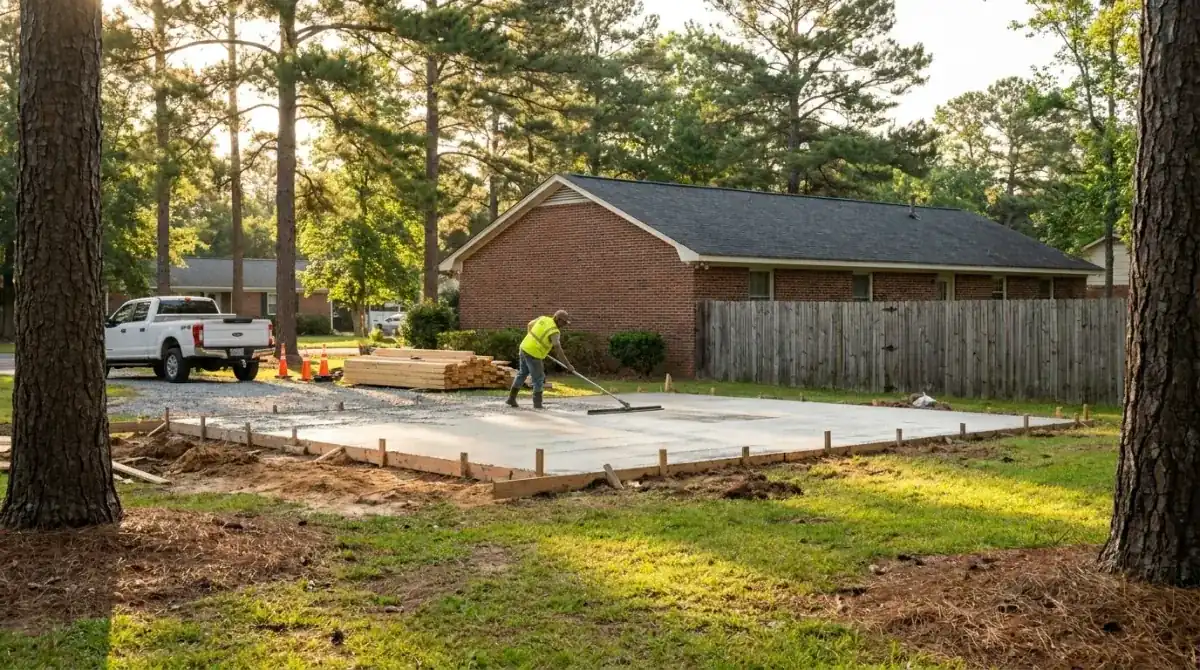
You can't pour off a map. As concrete contractors in Eastover, NC, we probe the lot, find where it goes from sand to wet, and set the grade and base to fit. Edges and downspouts are the worry on the dry ridges. On wet ground, drainage and a firm, well-compacted base decide how the slab ages. Both go in the estimate.