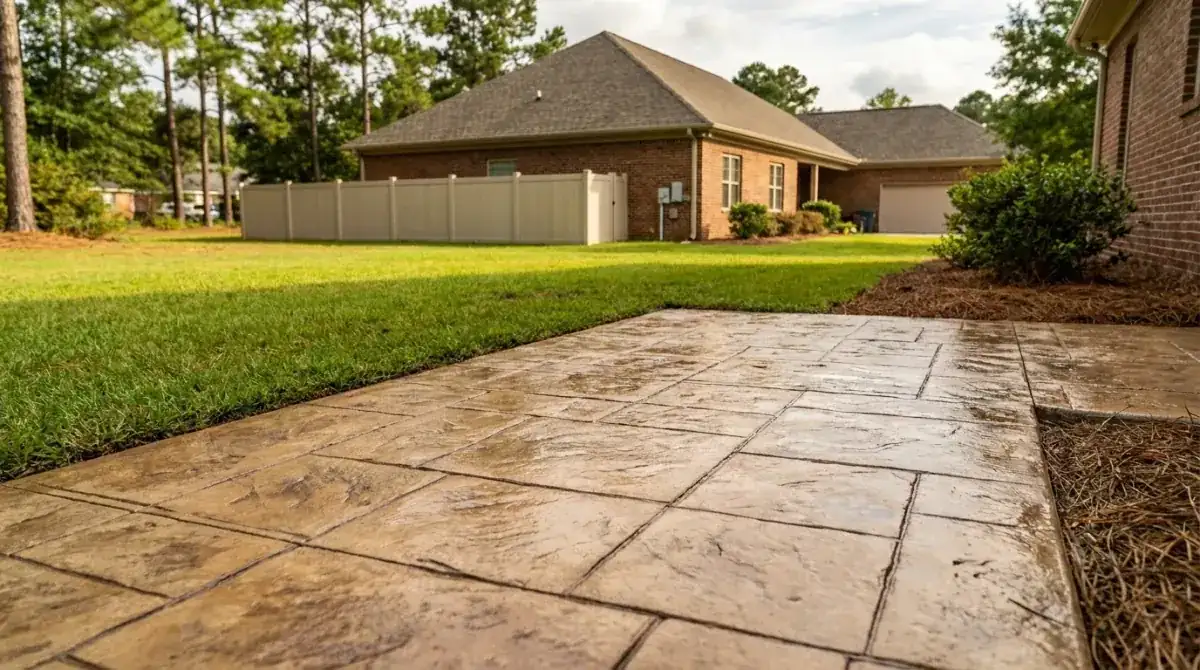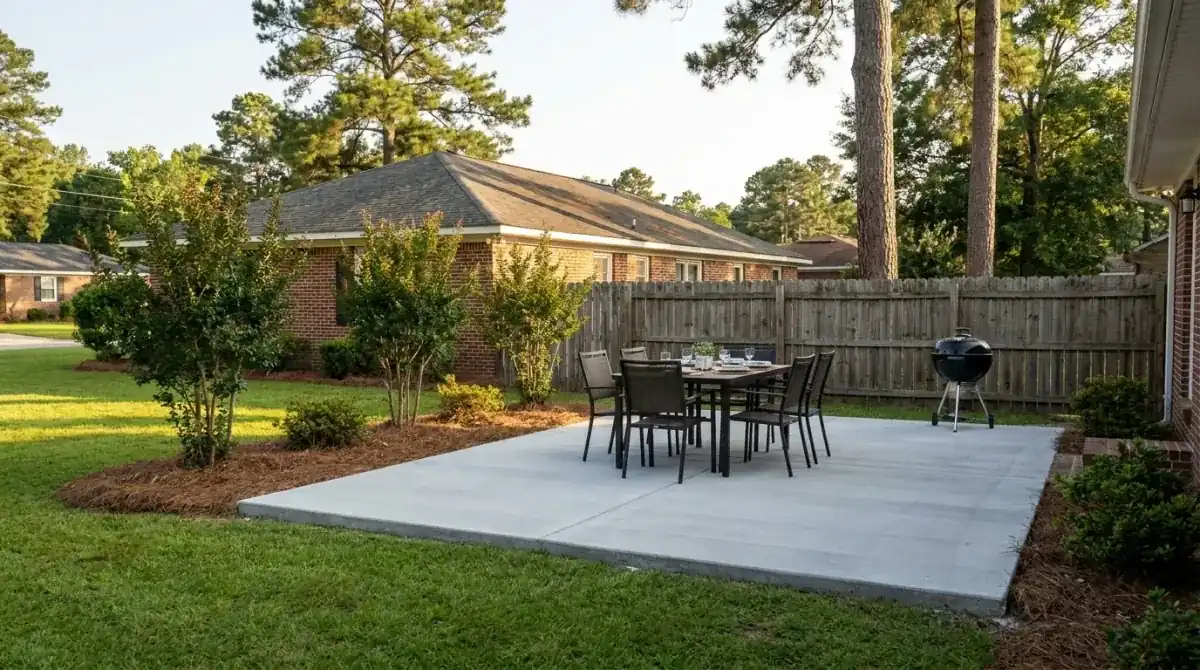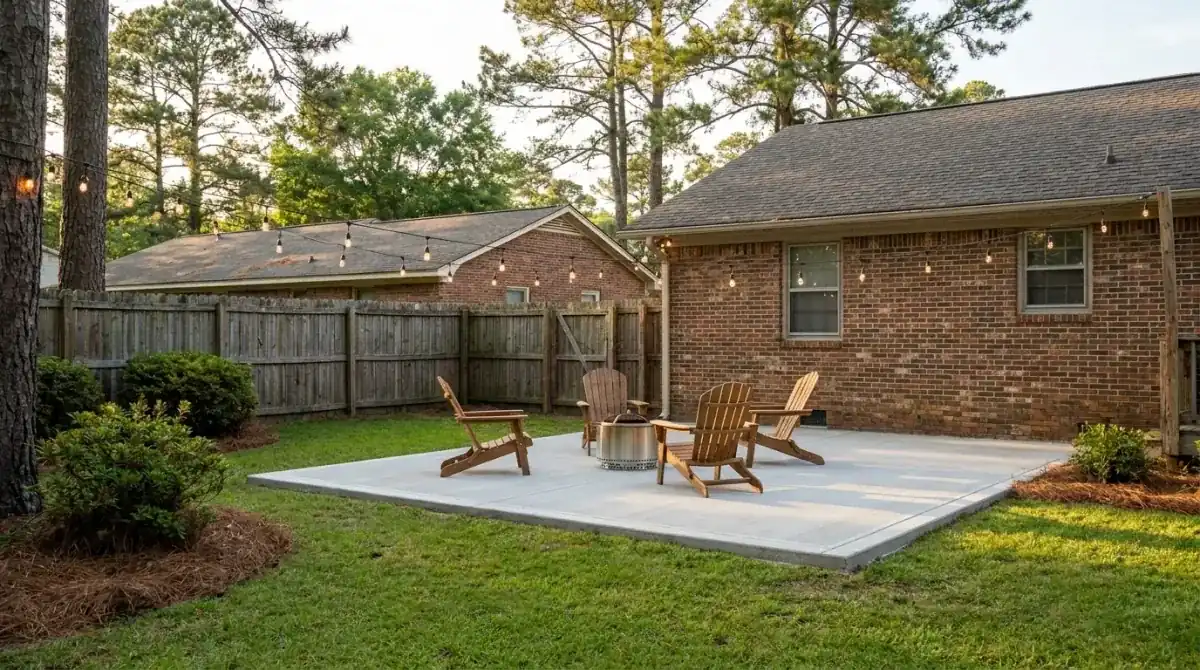
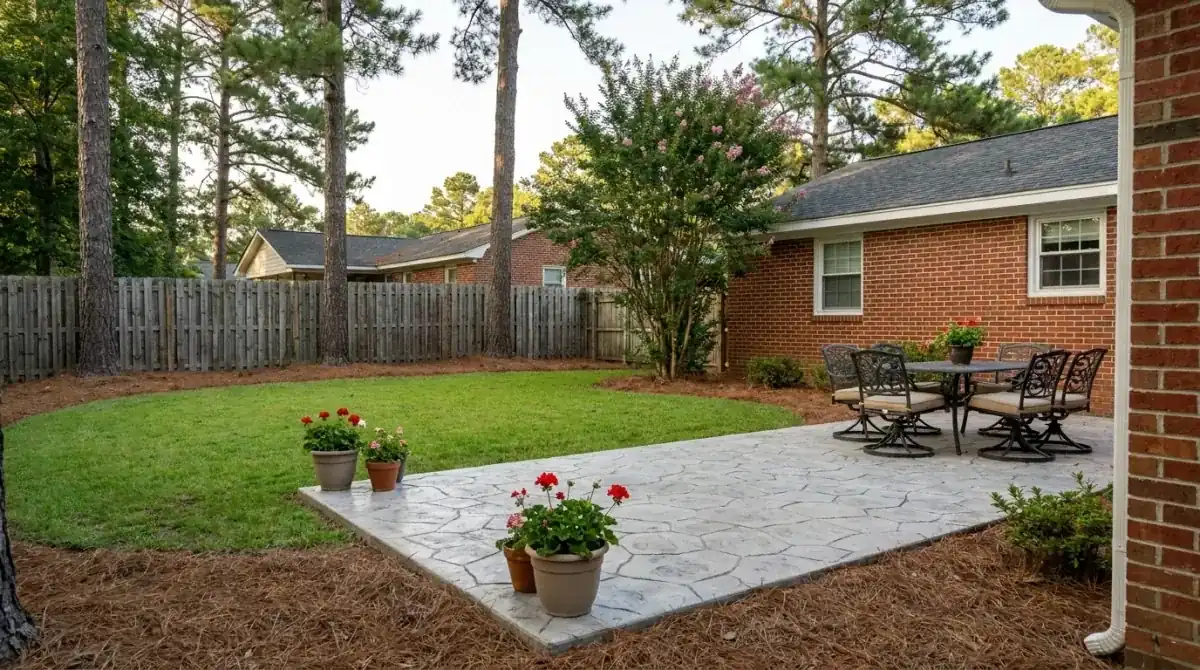
Pool deck contractors in Fayetteville: wet feet, hot sun and a slab that sheds water
A surround has a harder life than a patio. Barefoot kids and wet feet cross it all summer, the sun bakes it, and every splash puts water on a surface that has to send it somewhere. So the first job is to make the slab grip when it's wet, slope away from the water and the house, and stay put at the edge where it meets the shell.
Everything else follows from that. Finish, joints, color and base all trace back to what a wet, hot, barefoot surface asks of concrete. Below, we walk through each piece for Cumberland County yards: drainage, the edge, what finishes do in July, who permits what, and what to do with a slab that has already cracked or sunk.
One thing before the details. It's flatwork, and the same crew pours the patio and the walk to the back gate. Bundling them in one estimate saves a trip and keeps the grades matched.
Slope, drains and where the splash goes
Water that leaves the pool has to leave the slab. We form it with a slight fall away from the coping and away from the house wall, so splash and rain move to the lawn or a drain, not toward the foundation. We check the fall with a level and a hose before the concrete is ordered, because a flat spot is easy to fix in the forms and impossible to fix after the pour.
Sandy ground helps. The NRCS description of Lakeland soil, one of the big Sandhills series, calls it a deep, excessively drained sand with very rapid permeability, so water sinks quickly where it lands on grass. The risk is the edge. Sand washes out under a slab edge where runoff pours off, so we pack the shoulder and tell you where the runoff should land.
Where the water goes next matters in the city too. Fayetteville's stormwater code lets small projects skip stormwater control, but the exemption still says work may not send water onto a neighbor's property to cause damage. A slab on a lot line needs its fall pointed into your own yard. Bring us your survey and we'll show where the runoff ends up.
As pool deck contractors in Fayetteville, we price by the square foot, and ours runs $8 to $14 for broom or knockdown decks, which puts a 600 to 800 sq ft deck at $4,800 to $11,200. Stamped pool decks run $12 to $20.
| Job | Size | Per sq ft | What it comes to |
|---|---|---|---|
| Small spa or plunge surround | 400 sq ft | $8 to $14 | $3,200 to $5,600 |
| Standard surround | 600 sq ft | $8 to $14 | $4,800 to $8,400 |
| Larger surround with a patio edge | 800 sq ft | $8 to $14 | $6,400 to $11,200 |
| Wrap-around | 1,000 sq ft | $8 to $14 | $8,000 to $14,000 |
| Stamped surround | 600 sq ft | $12 to $20 | $7,200 to $12,000 |
Math is for a broom or knockdown finish. Tear-out of an old deck, truck access, pump reach and color move the number. We give a free written estimate after we see the yard.
Coping, the slab edge and the joint that lets them move
Coping is the cap on top of the pool wall, and it's where the deck meets the pool. If you're searching for concrete pool coping in Fayetteville, the first question is who's doing the shell and whether the coping is in that contract or in ours, because the cap and the slab have to agree on height and edge. We settle that at the estimate and write it down.
The shell and the slab move differently. They sit on different bases and take different loads, so we leave a joint between them and fill it with a flexible sealant, so the slab can shift a little without cracking the cap. The same rule applies where it meets the house.
Inside the slab, we plan the cracks. The Pennsylvania Aggregates and Concrete Association puts contraction joints no farther than 18 feet apart, cut to one quarter of the slab thickness, with panels no longer than 1.5 times their width. On 600 to 800 square feet that means joints that follow the corners of the shell and the lines of the house, not an arbitrary grid. Hairlines along those cuts are the slab doing its job.