The largest community in Harnett County has no town hall
Anderson Creek is a census designated place in Anderson Creek Township. Its 2020 population of 13,636 makes it the largest community in Harnett County, and it still has no municipal government. Don't go looking for a town office to hand out a driveway permit. The nearest counter is Harnett County Central Permitting in Lillington, and it covers permitting, inspections, plan review and planning.
The county's land use and zoning permit comes before a use is established or altered. It expires if you haven't started within 365 days and it does double duty as the watershed protection permit. Get that sorted before you book a pour date, so a crew isn't holding a calendar slot while the paper catches up.
Cumberland County and Hoke County run their own offices with their own rules, so a neighbor's story from Hope Mills won't carry over. Spout Springs, another unincorporated Harnett County community, runs on the same county rules as Anderson Creek. Our Spout Springs page walks through the inspection sequence, and the permit guide gives the county-by-county view.
Gilead and Blaney slopes: why grading sets the price here
Soil maps for 60 spots here show the pattern. Blaney loamy sand on 2 to 8 percent slopes came up 18 times, Gilead loamy sand on 2 to 8 percent slopes 12 times, Candor sand 6, Blaney on 8 to 15 percent slopes 5, and Gilead on 8 to 15 percent slopes 4. The ground rolls, with Candor sand and Lakeland sand filling the gaps between the loams.
On the gentle slopes both soils are fine for flatwork. Blaney is well drained and Gilead is moderately well drained, and NRCS gives the 2 to 8 percent units a low limitation rating for a house without a basement. The steeper units carry a rating of 0.633, so grading and form work cost more there. A patio that's level on paper may need a cut at the uphill edge and fill at the downhill one.
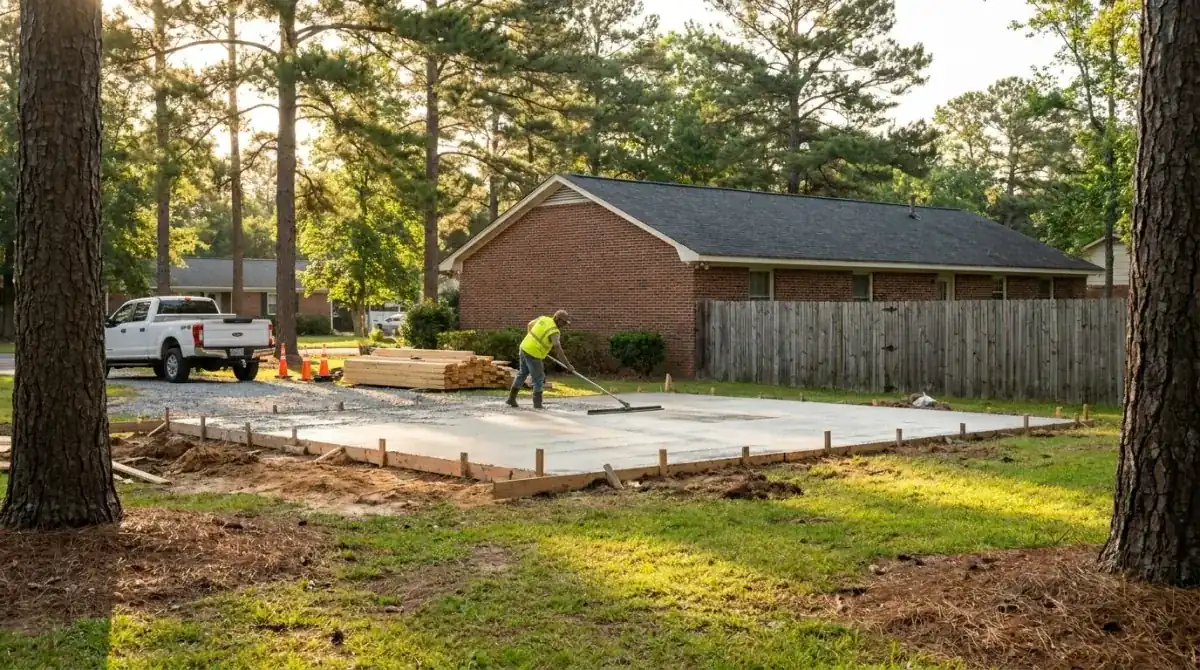
As concrete contractors in Anderson Creek, NC, we shoot grade before we price. A slab that sits half in cut and half on fill is asking for trouble, so we either bench the pad into the slope or build up the low side with compacted base. Our patio page and slab page show how we set thickness and joints for each.