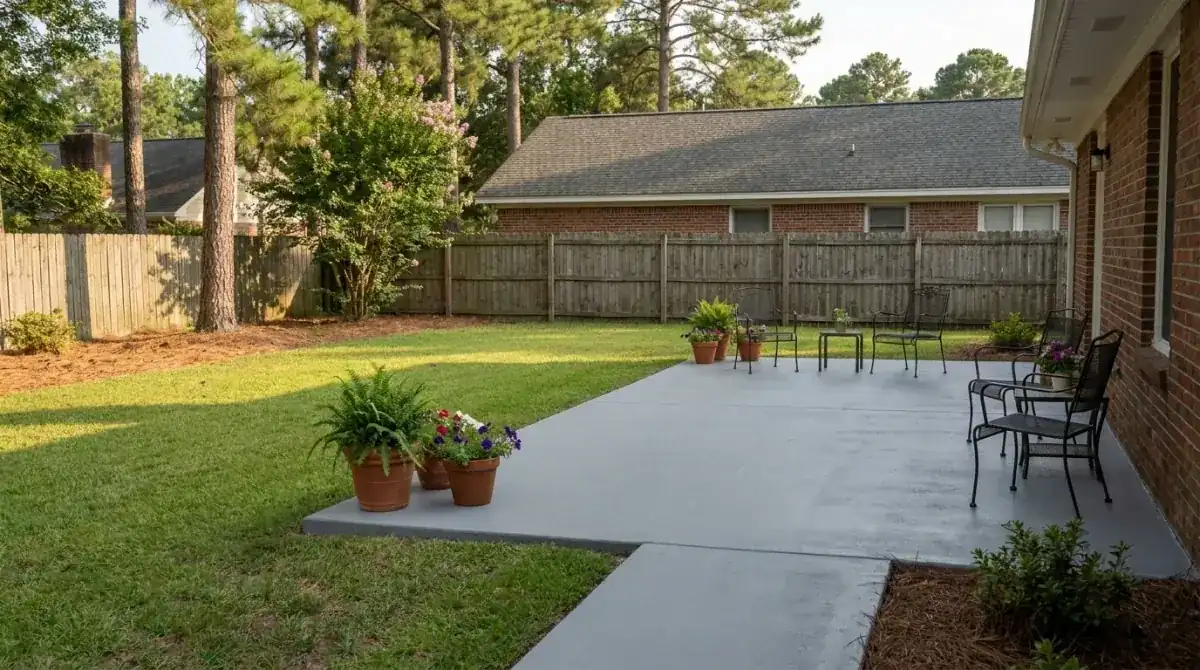
Goldsboro, Rains and Johnston: wet ground under backyards here
At 30 random points inside the town boundary, the USDA soil survey found Goldsboro loamy sand at 11, Rains sandy loam at 7, Norfolk loamy sand at 6, Johnston loam at 4 and Lynchburg sandy loam at 2. Only Norfolk is well drained. Goldsboro is moderately well drained, Rains is poorly drained, Lynchburg is somewhat poorly drained and Johnston is very poorly drained. That's 24 of 30 points on soils that hold water, a sharp contrast with the quick-draining sand in Hope Mills and Spring Lake.
The NRCS description of Goldsboro calls it an Aquic Paleudult, and aquic means seasonal wetness. For a slab, that changes the plan. We build a thicker stone base where the ground stays damp, hold the fall away from the house, and keep the pour off a soaked subgrade. A pad poured on a soft, soaked subgrade is the one that settles at a corner.
Timing matters as much as the base. Fayetteville's normal rainfall peaks in summer, with June through September running 4.87 to 5.36 inches a month at the airport, and the year brings 117.7 days with at least 0.01 inch of rain. So we watch the forecast and the ground together. A dry week after a wet one is when the subgrade is ready, not the first sunny morning.
One in ten sampled points sits in a mapped floodplain
A federal flood-map check at the same 30 points found 27 in minimal-hazard Zone X and three in Zone AE, the mapped 100-year floodplain. That one-in-ten share of AE points is higher than the same kind of check found in Hope Mills, Spring Lake, Raeford or Eastover. It's a sample, not a ruling on your parcel, so run your address through the NC Flood Risk Information System before any fill goes in.
In unincorporated Cumberland County, the county won't issue a building permit for construction in a Special Flood Hazard Area until Planning & Inspections issues a Floodplain Development Permit. Stedman is an incorporated town, but the town hands its permitting to the county, so the county floodplain office is where to ask. Tell us if the yard sits low or near a ditch, and we'll plan the edges and the drainage with that in mind.
Backyard slabs are priced by the square foot, $7 to $12 per sq ft for plain or broom finish, and stamped runs $12 to $20. These sizes come straight from those ranges.
| Project | Size | Per sq ft | What it comes to |
|---|---|---|---|
| Small seating pad | 12x12 (144 sq ft) | $7 to $12 | $1,008 to $1,728 |
| Mid-size family pad | 12x16 (192 sq ft) | $7 to $12 | $1,344 to $2,304 |
| Large entertainer pad | 16x20 (320 sq ft) | $7 to $12 | $2,240 to $3,840 |
| Stamped pad | 12x12 (144 sq ft) | $12 to $20 | $1,728 to $2,880 |
Small pads can hit a job minimum. Extra stone for wet ground, a pump for truck access and any step or seat wall move the number. We give a free written estimate after we see the site.