Why sand under a backyard slab still needs a built base
This town sits on very sandy Sandhills ground. In a USDA soil survey sample of points across town, the most common unit was Lakeland-Urban land complex, which is excessively drained. Candor sand came next, then the Wagram and Blaney loamy sands. Water doesn't stand on that ground, and that's a point in your favor.
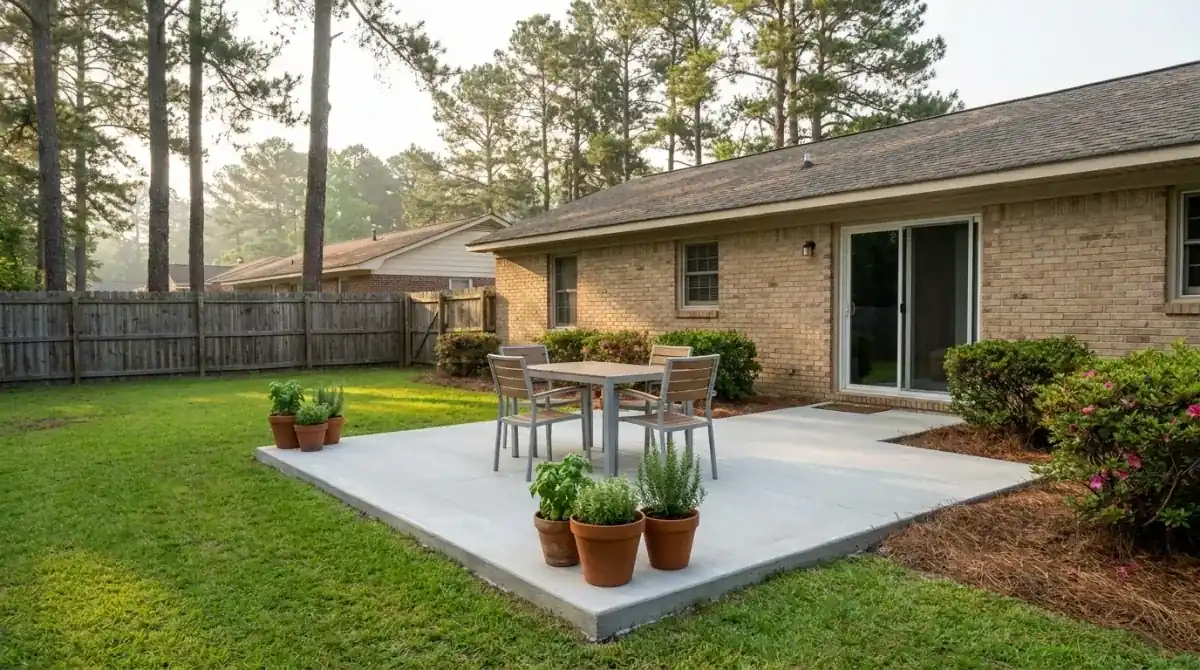
Sand has habits of its own. It compacts differently than clay, it slides out at the form edges, and it washes under a downspout. So the base gets compacted before the forms go in, the pad is set with a slight fall away from the house, and roof water is aimed well past the edge of the pour. The "Urban land" tag on those map units points to fill and past disturbance. On an older lot, we probe the spot before we price the base, because a buried stump or a soft fill pocket changes the number.
The Lakeland series description from the Natural Resources Conservation Service explains the rapid permeability behind all this.
Zoning permit questions for a slab behind a Hope Mills house
The town's Zoning Ordinance requires a zoning permit before construction of any building or structure starts, accessory structures included, and a permit goes void after six months without real progress. Whether a flat, ground-level pad counts is the town's call, so phone Development & Planning before you book anyone. The zoning page lists the department and the current ordinance.
Put a roof or a screened room over the slab and you're into building permit talk with Building Inspections & Permitting, at Town Hall on Rockfish Road. Say so on the first call, so the answer you get matches the project you'll actually build.
Setbacks matter too. The town's lot-size table lists a 30 foot front yard measured from the right-of-way line, side yards of 10 or 15 feet for a one-story house and a 35 foot rear yard. Check those numbers against the current ordinance for your zoning district before anyone stakes the corners. If your house falls inside the Municipal Influence Area, both the town's development standards and the county's zoning apply to you.
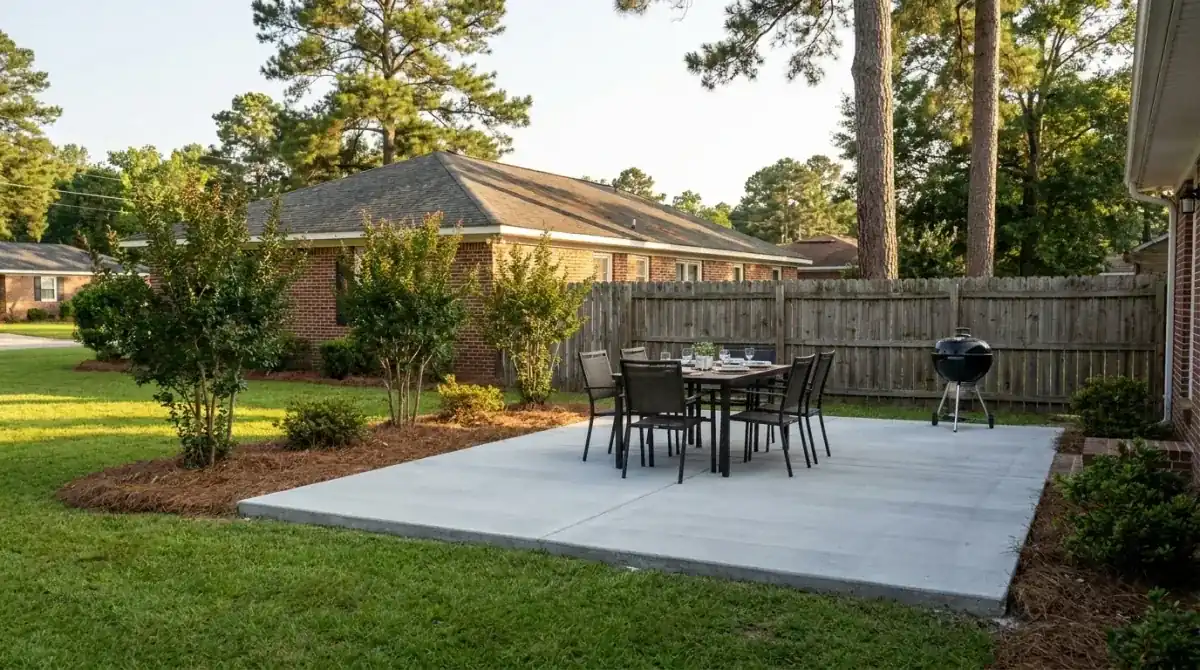
Backyard slabs are priced by the square foot, $7 to $12 per sq ft for plain or broom finish, and stamped runs $12 to $20. These sizes are worked straight from those ranges.
| Project | Size | Per sq ft | What it comes to |
|---|---|---|---|
| Back-door pad for a grill and two chairs | 10x12 (120 sq ft) | $7 to $12 | $840 to $1,440 |
| Family table and chairs | 12x16 (192 sq ft) | $7 to $12 | $1,344 to $2,304 |
| Entertainer layout | 16x18 (288 sq ft) | $7 to $12 | $2,016 to $3,456 |
| Stamped pad | 12x14 (168 sq ft) | $12 to $20 | $2,016 to $3,360 |
Small pads can hit a job minimum. Base work on sand, a lakeside grade and any step or seat wall move the number. We give a free written estimate after we see the site.