Sand, a creek and a lake dam: what a bank here is made of
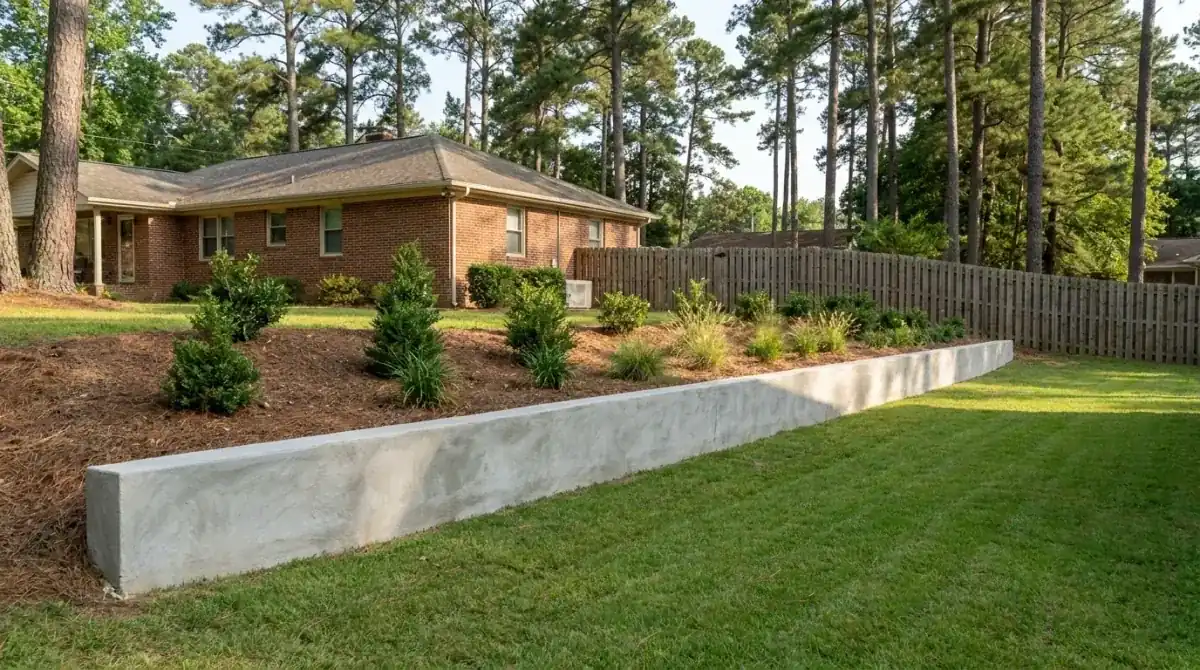
The soil survey spots inside town lines tell you what you're holding back. Of 30 spots read, 8 came back Lakeland-Urban land complex, 7 Candor sand, 4 Wagram-Urban land complex and 4 Blaney loamy sand, plus two of Pactolus loamy sand. That's sand that sheds water fast, and a concrete retaining wall here has to be built for it. NRCS describes Lakeland soils as excessively drained, with rapid to very rapid permeability. Rain leaves the yard quickly, and it carries fine sand out through the toe of any bank it crosses.
The town knows what loose water does. Heavy rain on Memorial Day 2003 washed out the earthen dam that held the lake on Little Rockfish Creek, and a concrete dam finished in 2008 replaced it, as WRAL reported. Your grade change is a smaller job, but with the same lesson: steel and concrete that hold, and a plan for where the water goes.
Concrete retaining walls in Hope Mills beside a driveway: curb cuts, ditches and Public Works
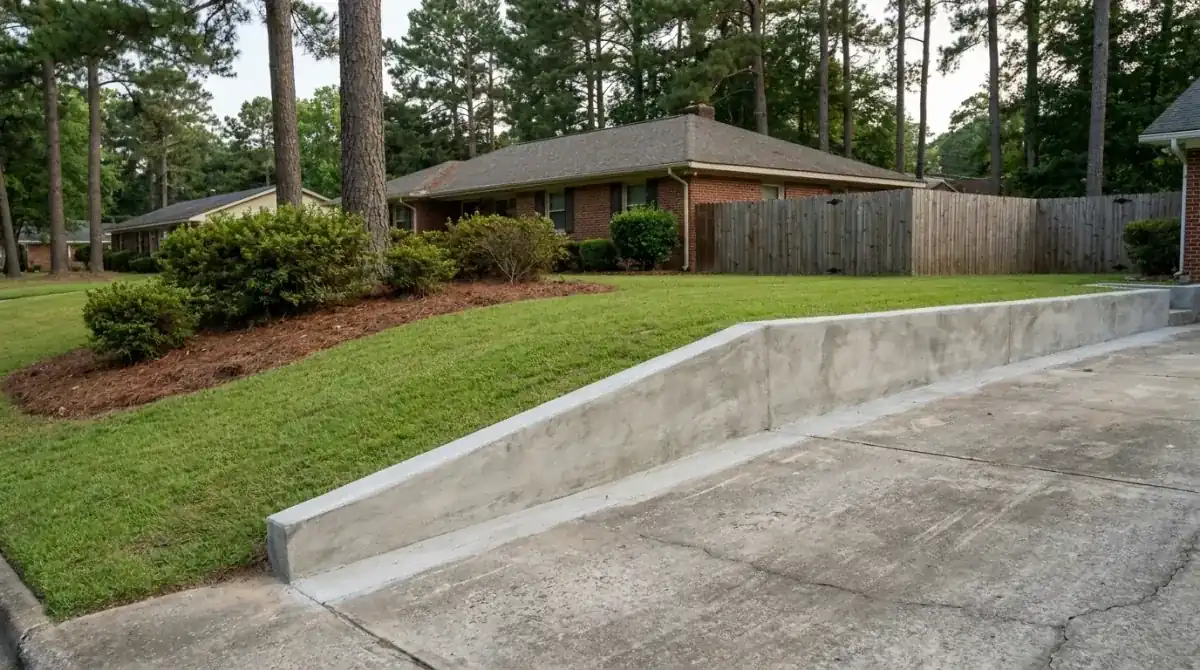
A cut into the bank beside a driveway puts the job under the town's driveway rules. Residential driveways here top out at 24 feet wide, and the first 20 feet from the street connection has to be asphalt or concrete, per the town's driveway permit page. If the work removes existing curbing, Public Works inspects first and approves it before the permit is issued. A Public Works representative also has to inspect while the contractor works, so book that visit at least 24 hours ahead.
Drainage counts as permit work too. The town's right-of-way page lists new driveway connections and changes to roadside ditches, such as piping a ditch or replacing a driveway pipe or culvert. A drain line that empties into the street ditch can land in that category, so ask Public Works before it's built. We pick the outlet before we dig, so you know up front whether the right-of-way is part of the job. Work there without a permit can be stopped and removed at the owner's or contractor's expense.
On a state-maintained road the call belongs to NCDOT, not the town. The town points residents to an NCDOT public street map to check who maintains your street. Settle that first, because it decides whether you're talking to Public Works or to a district engineer.
We price walls here by the square foot of face, $25 to $45 per sq ft, poured or block up to about 4 feet. Length times height gives you the face.
| Job | Size | Per sq ft of face | What it comes to |
|---|---|---|---|
| Lakeside seat run | 25x2 ft (50 sq ft) | $25 to $45 | $1,250 to $2,250 |
| Cut beside a driveway apron | 30x3 ft (90 sq ft) | $25 to $45 | $2,250 to $4,050 |
| Back-yard terrace | 45x3 ft (135 sq ft) | $25 to $45 | $3,375 to $6,075 |
| Tall bank | 60x4 ft (240 sq ft) | $25 to $45 | $6,000 to $10,800 |
| Over about 4 ft | Engineered | Per design | Priced after the drawings |
That's length times height times the range and nothing more. Footing depth, drain stone, steps through the face and how close the truck can get move the number. We give a free written estimate after we see the site.