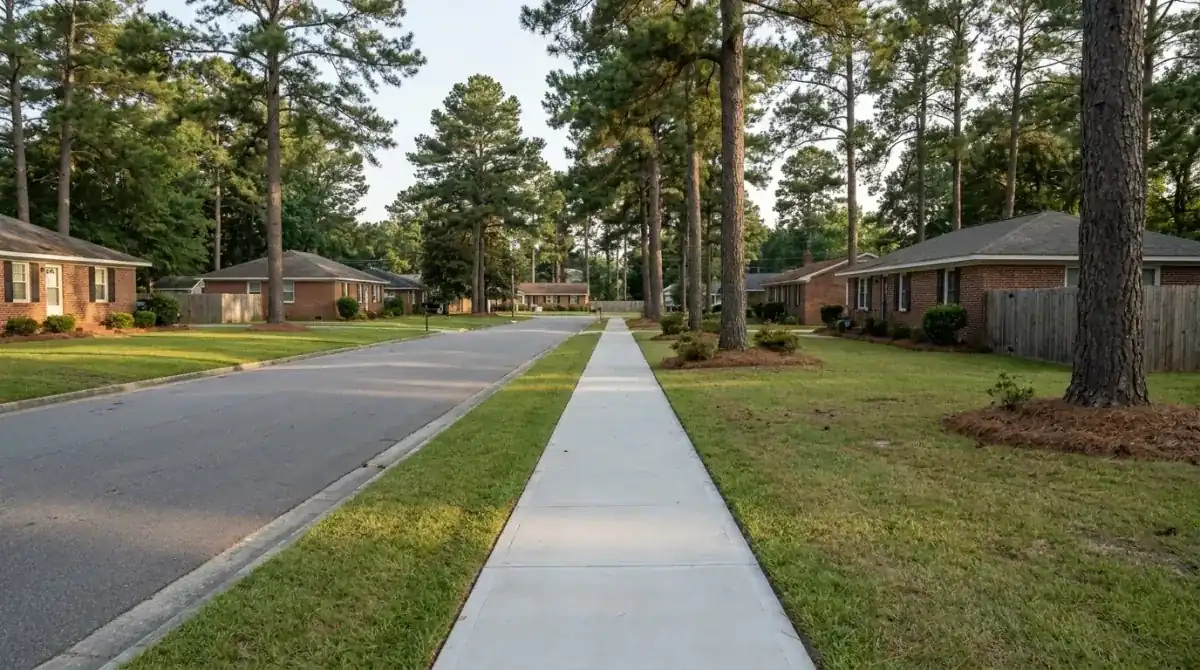
Walks skip the under-slab inspection, but the building permit still has gates
The Town's required-inspections handout carves out flatwork: inspection of driveway slabs, carport slabs, patio slabs, walks and the like is not required. That exception covers the under-slab check that building slabs get before the pour. It doesn't tell you whether a walk needs a permit, and it doesn't cover the right-of-way work above.
If the walk belongs to a new house or an addition, the residential building permit packet sets the order. Approval of the driveway, erosion control and water and sewer service (or septic approval) has to be in hand before the building permit is issued. Applications go through the Town's SmartGov portal, and the packet asks for a Certificate of Appropriateness if the property sits in the Historic District. Inspections are booked at least 24 hours ahead by phone, never by voicemail.
Timing is the other gate. NOAA's normals for Fayetteville Regional Airport count 46.9 days a year with a low at or below 32 F, mostly December through February, and ACI 306 guidance treats air temperatures below 40 F as cold-weather pouring. A winter walk in Southern Pines gets protection after the pour and never goes onto a frozen base. Summer runs the other way, with 70.5 days a year at 90 F or higher, so those pours start early and get kept damp.
For a standalone walk on an existing lot, the UDO's zoning permit language covers a new use, a building or a site modification. Whether your walk lands in that category is the Town's call. Our permit guide shows how the other offices around Fayetteville handle the same question.
Walks in town price by the square foot at $7 to $13 per sq ft, or $28 to $52 per linear foot at 4 feet wide. Short runs hit a job minimum. The sizes below are examples.
| Job | Size | Per sq ft | What it comes to |
|---|
| Front walk, 5 feet wide | 5x35 (175 sq ft) | $7 to $13 | $1,225 to $2,275 |
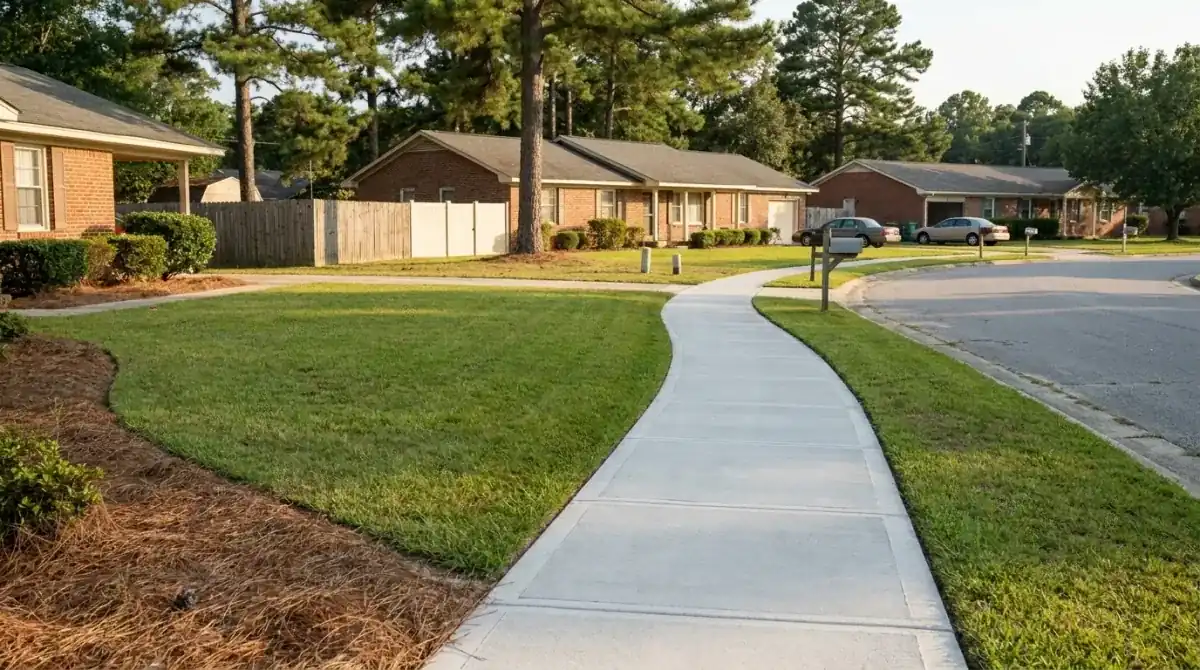
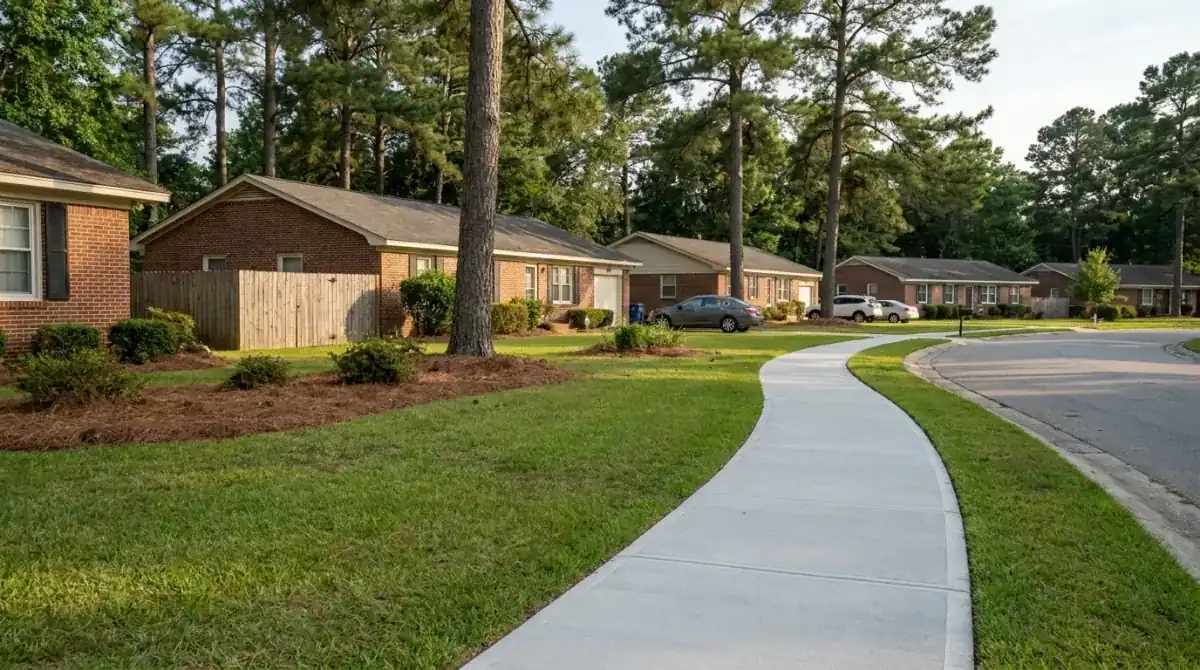
| Street-to-door walk with a bend | 4x60 (240 sq ft) | $7 to $13 | $1,680 to $3,120 |
| Wide approach with a landing | 6x50 (300 sq ft) | $7 to $13 | $2,100 to $3,900 |
Figures assume a 4-inch walk on a compacted base. Tear-out of an old walk, root work, right-of-way restoration and steps change the total. The pricing guide shows how a number is built. We give a free written estimate after we see the site.
Candor sand, a dense subsoil layer and the watershed overlay
Of 40 spot-checked points inside the town boundary, Candor sand or Candor-Urban land complex took 21, a little over half. It is sandy and somewhat excessively drained. Ailey loamy sand took 9 points and Vaucluse loamy sand took 6. Vaucluse has a fragipan layer, a dense zone in the subsoil that can slow water moving down. Bibb loam, mapped as frequently flooded, took 3 points.
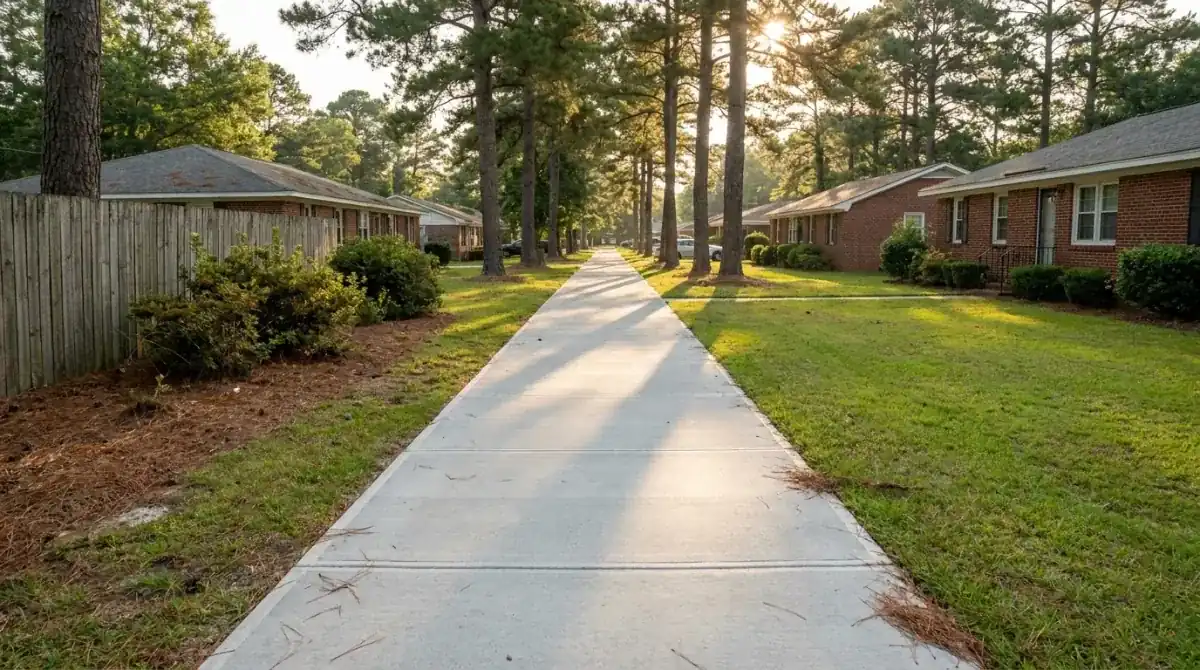
Slabs shrink on average about 1/8 inch in 20 feet, which is why a long walk is cut into panels. PACA puts the maximum joint spacing at 18 feet, says panels should run no longer than 1.5 times their width and has the saw cut go a quarter of the slab depth. On a 4-foot walk that keeps the joints no more than 6 feet apart, and we cut them as soon as the surface can be sawed without raveling, because waiting raises the chance of a random crack.
The town sits in Moore County, with US 1 running through town. The center is high ground that drains west toward Aberdeen Creek and east and north toward Little River tributaries, so water leaves quickly.
On Candor sand the base work is about holding the edge. We compact in lifts, pack the shoulders and keep downspouts from cutting a trench beside the slab. Where Vaucluse shows up, the dense layer means we watch for water sitting in the base after a storm and leave the stone course thick enough to let it drain.
The UDO also carries a Watershed Protection Overlay with built-upon area limits. In the Rest of Watershed (WS-III) category new development is capped at 2 dwelling units per acre or 24 percent built-upon area, and the most protected zone is capped at one unit per acre or 12 percent. Built-upon area means impervious and partially impervious surface, and a slab is impervious. If your lot already carries a big driveway, the Town can tell you whether the overlay applies to your parcel before you add a walk.